

Fermi Cycle 4 Guest Investigator Program Information
The Fermi Cycle 4 Guest Investigator (GI) proposals will be due on January 21, 2011. Several changes to the program are planned for Cycle 4. A joint Fermi-Suzaku program has been implemented through an agreement with the Suzaku project. Through this program Suzaku observing time can be awarded to successful proposers to the Fermi Guest Investigator Program. Another change is the possibility to propose for projects of two years duration. Please refer to the Fermi amendment to the Fermi Amendment to the 2010 ROSES NRA for details on these opportunities. More information will be appearing here shortly. The ARK/RPS proposal submission system for Fermi Cycle-4 will go online in the near future as well.
Fermi Cycle 3 Guest Investigator Program Information
Information on Fermi Cycle-3 Phase-2 proposal submission is available here.
The Guest Investigations for Fermi's Cycle-3 Science Program have been selected by NASA HQ based on peer-review recommendations. The peer review was held in mid-April 2010. Over 40 reviewers, including about 10% foreign participants, evaluated 192 proposals. Ten of these were requests were for continuation of Cycle-1 or 2 multi-year awards. A total of 77 cycle-2 programs were selected. This number includes 2 "Large Projects", which are multi-year awards with a larger budget cap than the regular one-year proposals. The titles and abstracts of the selected programs are available here. The Cycle-3 Program begins in mid-August 2010 and lasts for one year.
No specific pointed observations - ToO or scheduled - were approved. The Joint-Time Allocation agreements between Fermi and NRAO and NOAO led to the selection of 14 joint programs involving 880 hours of radio and 89 hours of optical observing time (final approval and scheduling of NRAO and NOAO will be made by those organizations).
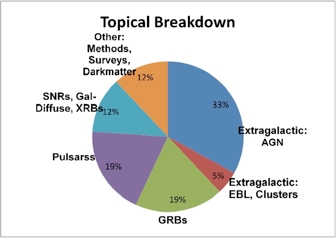
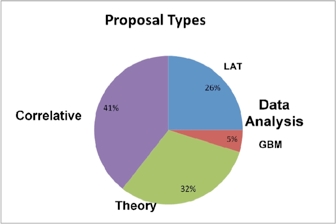
Proposal selection statistics by science category and by proposal type are illustrated in the accompanying charts. No a priori quotas are imposed on science topics or proposal types. While extragalactic science, predominantly AGN studies, remains the most popular study area, the proportion of pulsar and GRB programs has increased, which we attribute to the impressive suite of early results. The proportion of theoretical investigations increased significantly from 22% in cycle 2 to 32%, which is attributable to the emergence of new and unexpected observational results in need of deeper interpretation.
IMPORTANT! Properties of the Fermi GI Program
Cycle-3 Guest Investigator Proposals were due February 5, 2010. Selected investigations will begin in the third year of Fermi's science observations, i.e., starting in mid August, 2010. The information below is retained as a historical reference.
In Cycle 3 there will be two proposal classes: (1) Regular proposals with research plans that can be completed in one year and (2) Large proposals whose research plans are more expansive and may take up to three years to complete. Grants for regular proposals will be up to $100K with an average range of 50-80K, while large grants will be up to $200K per year with an average range of 100-200K per year. Large projects will be reviewed before each of the two cycles following the cycle of the initial award to determine if appropriate progress is being made toward the proposed objectives. It is anticipated that up to 3 new large projects will be selected for Cycle-3.
Synopsis of the Fermi GI Program:
- Fermi PIs can propose to:
- Analyze GBM or LAT event data from the beginning of science operations
- Analyze higher level data released by the LAT: lightcurves and spectra of ~45 bright sources; light curves and spectra of transients; and a point source catalog.
- Carry out pointed LAT observations. However, proposers should be aware that very strong science justifications will be required in view of the probable low additional scientific benefit of such observations see the Fermi Users' Group (FUG) analysis at http://fermi.gsfc.nasa.gov/ssc/proposals/pointing_analysis/. Pointed observations will follow the same open data policy as sky survey data, i.e., they will become public immediately.
- Support correlated observations of gamma-ray sources at other wavelengths that are directly relevant to Fermi.
- Perform theoretical studies of gamma-ray sources.
- Obtain observing time on NRAO and NOAO facilities n support of Fermi-related science..
- Fermi proposals may be submitted by investigators at both US and non-US institutions, but only PIs or Co-Is sited at US institutions may receive funding from NASA. Proposals without any investigators sited at a US institution will be evaluated (such an evaluation may assist an investigator obtain funding from a foreign funding agency), may result in a pointed LAT observation, or may be awarded NRAO and NOAO observing time.
Schedule and Checklist of Required Items for a Complete Fermi Proposal Submission
Proposers are urged to read carefully the Description of the Fermi Guest Investigator Program for Cycle 3 (i.e., Appendix D.8 of ROSES-09). Below we distill the highlights.
Fermi's Cycle 3 proposal process will have two Phases. In Phase 1 you will submit a cover page and a scientific justification; the cover page (generated by a webform) will include a maximum budget cap and the scientific justification should include a brief management section that describes the resources required (e.g., FTE). The page limit for this section is 4 pages for a Regular proposal, and 6 pages for a Large proposal. An additional page describing proposed NRAO or NOAO observations must be added if you are applying under the 'joint proposal opportunity.' A peer review panel will review your Phase 1 proposal, and you will submit a Phase 2 budget proposal only if your Phase 1 proposal has been tentatively accepted.
As a resource for Cycle-3 proposers, the titles and abstracts of proposals approved for Fermi Cycle-2 can be obtained here.
PIs of Large (multi-year) projects approved in previous cycles must submit a progress report annually on the Phase 1 proposal due date (rather than on the anniversary of the award date). A Large project may be funded for a total of 3 years.
Proposal submission is fully electronic. No paper copies are required. For Fermi's Cycle 3, the Phase 1 (science/technical/management) proposals must be submitted via ARK/RPS. Phase 2 budget proposals will be submitted through NSPIRES. Both systems require simple registration before use-see below for details.
Schedule for Fermi Cycle 3
| Announcement (as part of ROSES 2008) | September, 2009 |
| Release of online proposal aids and documentation | November, 2009 |
| Notices of Intent (optional) | November 16, 2009 |
| Proposals Due | February 5, 2010 |
| Proposal Peer Review | late April, 2010 |
| Phase-2 Proposal Solicitation | mid May 2010 |
| Final Selections Announced | June, 2010 |
| Fermi Cycle 3 Begins | mid August, 2010 |
Checklist
- Register now
Before submitting proposals, you must register with the relevant systems (below).
- Register with ARK/RPS at GSFC. This system will be used for Phase 1 of the proposal process. Assistance can be found at http://heasarc.gsfc.nasa.gov/ark/rps/help/quick/.
- Even though you will only use RPS for the Phase 1 proposal, register with NSPIRES in plenty of time to submit your Phase 2 (budget) proposal, and to assist us evaluate your Phase 1 (science/technical/management) proposal. Use the "Registration Information" section of the NSPIRES Homepage, if you don't already have an NSPIRES account. Requests for assistance should be addressed to nspires-help@nasaprs.com.
- Phase 1 Proposal Submission - due February 5, 2009, 4:30 pm EST
Required Items for a Complete Fermi Cycle 3 Phase 1 proposal submission:
- A cover page submitted electronically via ARK/RPS. The help file specific to Fermi provides detailed explanations of the various entries. On this cover page you will include:
- Contact information for all investigators
- Abstract
- Proposal categorization (large/regular, type of source studied, type of proposal)
- Identification of joint programs (if relevant) - the current programs are the NRAO-Fermi and NOAO-Fermi cooperative agreements, and NASA's High-End Computing (see section Id of the Summary of Solicitation).
- NRAO or NOAO resources requested (if relevant)
- Maximum Budget Request-this is the maximum funding request you will make if your proposal is accepted, in thousands of dollars. For a multi-year large proposal, enter the budget for the first year only. Regular proposals may request up to $100K and large proposals up to $200K per year.
- NASA FTE Commitment-this is the number of FTEs of NASA civil servant time that will be supported by the program if the proposal is accepted. This is not the total number of FTEs that will be devoted to the research program. Most likely the value will not be an integer.
- Target forms (if relevant)-source name, position, and type are required. NRAO and NOAO joint proposals, and LAT pointed observations, are required to enter the requested observing time for the target. Additional information should then be provided for LAT observations. A file with a list of targets can be uploaded by clicking on the 'Add Targets' button at the top and bottom of the form.
- A single PDF file containing the text of your scientific justification uploaded via the RPS Web site. The page limit for the scientific justification is 4 pages for a Regular proposal, and 6 pages for a Large Proposal. If you are applying for NRAO or NOAO observing time under the 'joint proposal opportunity' then you must add an additional page describing the observations. The PI's Vita is not required. The font shall be no smaller than 10 pt, and need not include section headings. Figures and references are included in the page limit. Pages should have at least 1-inch (2.5 cm) margins on all sides. This text should include:
- Scientific description of your research plan.
- A short statement demonstrating the relevance of the proposed research to NASA's objectives (see Table 1 of the Summary of Solicitation).
- A management section that describes the resources required, including the expected contribution of the different investigators. This section should provide an estimate of the level of effort (e.g., 0.5 FTE of a postdoc), and the maximum budget request. If you are submitting a multi-year large proposal, please qualitatively describe the level-of-effort profile.
- If you are proposing for NRAO or NOAO observing time under the 'joint proposal opportunity,' you must add an additional page to the scientific justification describing the observation. This page will be read for a technical evaluation of your observation plan, and should not be used to continue the scientific justification for the observation. The information required for NRAO observations can be found here, and for NOAO observations here. Note that you cannot apply for more than 200 hours or Target-of-Opportunity radio observations through the NRAO joint proposal opportunity, or for Target-of-Opportunity or survey program optical observations through the NOAO joint proposal opportunity, but must instead apply through the cooperative proposal opportunity of each program.
- If you are proposing for funding under the NRAO-Fermi or NOAO-Fermi 'cooperative proposal opportunity,' please indicate this clearly in the science justification. You may not add an additional page describing the observations, but you should briefly justify the planned observations. Your proposal through the regular NRAO or NOAO proposal process must be reviewed by the relevant Time Allocation Committee (TAC) before the Fermi peer review panels; the TAC evaluation of your observing proposal will be forwarded to the Fermi peer review panel evaluating your Fermi funding proposal.
Proposals to analyze released LAT data on a particular source, perform correlated multiwavelength observations of a source, model a source or repoint the Fermi observatory, also require electronic submission of an ARK/RPS target form containing the source name and position (RA and Dec) of the target.
Proposals must be received by 4:30 PM EST February 5, 2010. If you have difficulties submitting your proposal or have technical questions about the Fermi mission, see our Getting Help section.
- A cover page submitted electronically via ARK/RPS. The help file specific to Fermi provides detailed explanations of the various entries. On this cover page you will include:
- Phase 2 Proposal Submission
You will submit a phase 2 (budget) proposal only if your phase 1 proposal has been (tentatively) accepted. You will receive instructions in that happy event.
Supporting Materials for Submitting Fermi Proposals
- The Fermi Technical Manual contains information about the Fermi mission, instruments, performance, and technical feasibility.
- The 2009 NASA NRA Proposers Guidebook contains instructions for submitting proposals.
- Web-based proposal aids such as a LAT source detectability tool tools are available on the Fermi Science Support Center Proposal Tools page.
- The LAT one-year source catalog has been released and is available on the FSSC web site.
Getting Help
If you have problems with the first Phase proposal and target forms in the ARK/RPS system, please see the ARK/RPS Quick Help page; questions about ARK/RPS should be sent to the
If you have questions or problems with the NSPIRES system, please consult the NSPIRES Help Page, or submit your technical support question to nspires-help@nasaprs.com.
If you have questions about the Fermi instruments, mission, simulation tools, or overall proposal program, please contact the Fermi Science Support Center Help Desk.
If you'd like to be a Peer Reviewer
The Fermi Cycle 3 Peer Review will tentatively take place between April 18 and 21, 2010, in Baltimore, MD. Travel and per diem will be supported by NASA, and participants typically spend 2-3 days at the review. Reviewers must have a PhD at the time of the Peer Review.
If you would like to be considered as a reviewer, please send an e-mail to the HEASARC Peer Review mailbox.


- Curator: J.D. Myers
- NASA Official: Elizabeth Hays
- Fermi FAQ, Comments, Feedback
- › Privacy Policy and Important Notices
- › Accessibility
- › Contact NASA
- › Page Last Updated: Tue, Jan 31, 2012