
What is Fermi?
 The Universe is home to numerous exotic and beautiful phenomena, some of which can generate almost inconceivable amounts of energy. Supermassive black holes, merging neutron stars, streams of hot gas moving close to the speed of light ... these are but a few of the marvels that generate gamma-ray radiation, the most energetic form of radiation, billions of times more energetic than the type of light visible to our eyes. What is happening to produce this much energy? What happens to the surrounding environment near these phenomena? How will studying these energetic objects add to our understanding of the very nature of the Universe and how it behaves?
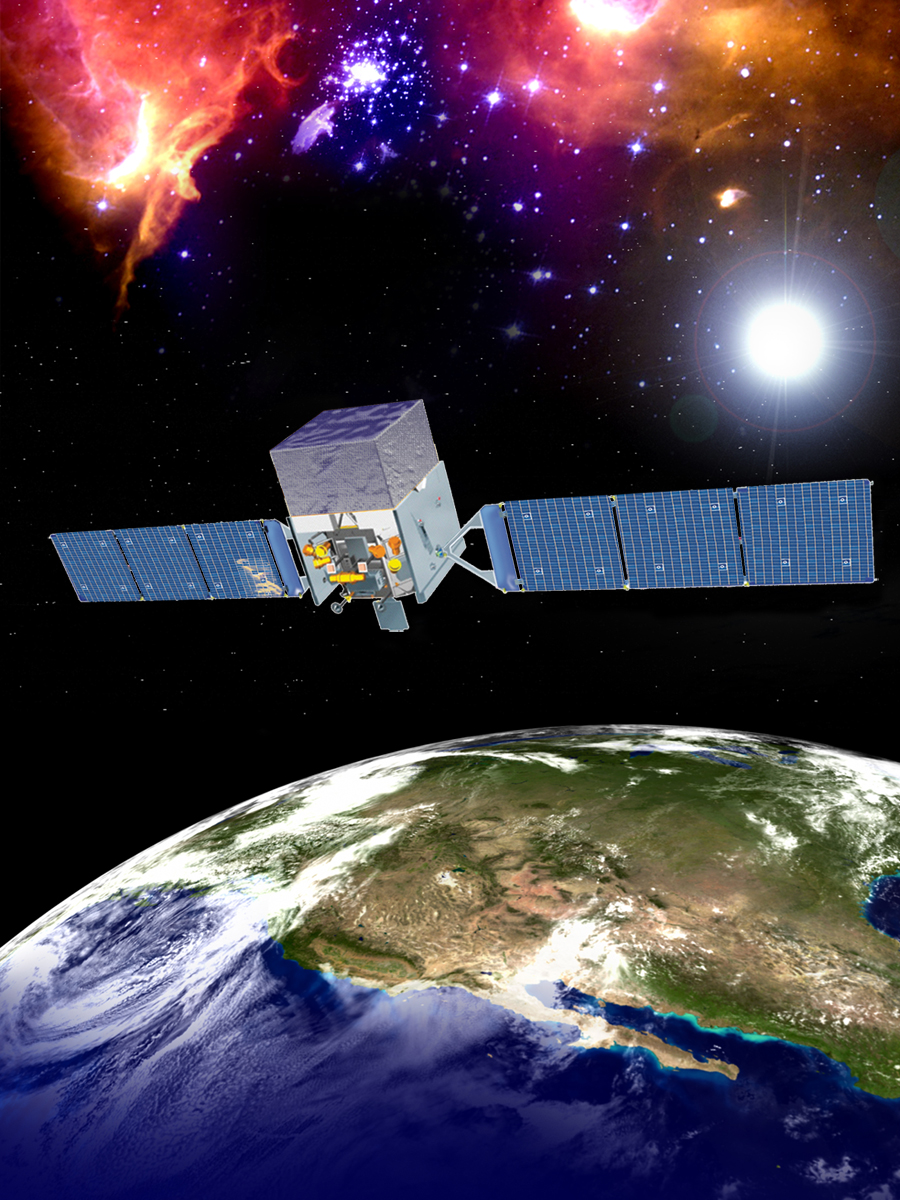
The Fermi Gamma-ray Space Telescope, formerly GLAST, is opening this high-energy world to exploration and helping us answer these questions. With Fermi, astronomers at long last have a superior tool to study how black holes, notorious for pulling matter in, can accelerate jets of gas outward at fantastic speeds. Physicists are able to study subatomic particles at energies far greater than those seen in ground-based particle accelerators. And cosmologists are gaining valuable information about the birth and early evolution of the Universe.
For this unique endeavor, one that brings together the astrophysics and particle physics communities, NASA has teamed up with the U.S. Department of Energy and institutions in France, Germany, Japan, Italy and Sweden. General Dynamics was chosen to build the spacecraft. Fermi was launched June 11, 2008 at 12:05 pm EDT.
Latest News
Apr 23, 2024
Explore the Universe with the First E-Book from NASA's Fermi
To commemorate a milestone anniversary for NASA's Fermi spacecraft, the mission team has published an e-book called "Our High-Energy Universe: 15 Years with the Fermi Gamma-ray Space Telescope."
+ Read More
Apr 16, 2024
NASA's Fermi Mission Sees No Gamma Rays from Nearby Supernova
A nearby supernova in 2023 offered astrophysicists an excellent opportunity to test ideas about how these types of explosions boost particles, called cosmic rays, to near light-speed. But surprisingly, NASA's Fermi Gamma-ray Space Telescope detected none of the high-energy gamma-ray light those particles should produce.
+ Read More
Apr 5, 2024
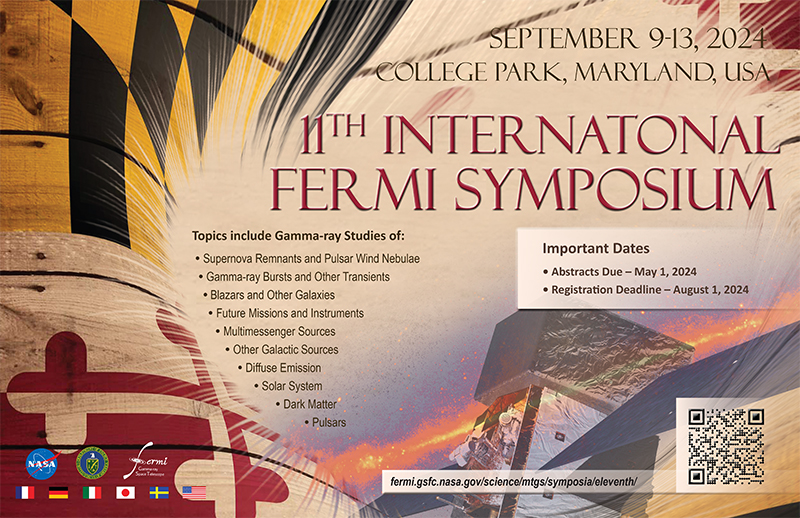
11th International Fermi Symposium
Please join us in College Park, Maryland, USA on September 9-13, 2024 for the next Fermi Symposium. Abstracts are due May 1st. More information is available at the Symposium website.

- Curator: J.D. Myers
- NASA Official: Elizabeth Hays
- Fermi FAQ, Comments, Feedback
- › Privacy Policy and Important Notices
- › Accessibility
- › Contact NASA
- › Page Last Updated: Fri, Apr 05, 2024