
New Fermi Users
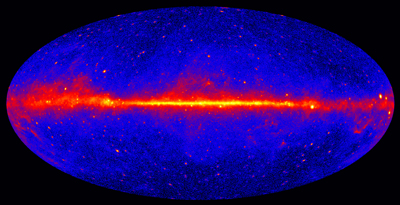
This page is intended as a brief introduction for astronomers who primarily have experience with telescopes that target an individual source to produce an "observation". Fermi constantly scans the sky producing a continuous list of photons accumulated over the lifetime of the mission. The gamma-ray sky also has a very bright background. These two facts mean that Fermi data analysis is very different from other wavebands. This page provides pointers for new users.
Fermi Basics
-
The Fermi Gamma-ray Space Telescope is the most sensitive gamma-ray telescope ever launched. The main instrument is the Large Area Telescope (LAT) which continuously scans the sky. The Gamma-ray Burst Monitor (GBM) detects gamma ray flashes due to gamma-ray bursts, magnetars, solar flares, thunderstorms and other fast, high-energy activity
An overview of the mission, instruments, and science focus can be found on the About Fermi
-
Many science questions can be addressed by using high level data products provided by the Fermi mission and other members of the Fermi community. They are listed on the Fermi data page and include:
- The LAT 14 year source catalog - a catalog of 7000+ gamma ray sources from 14 years of data. Some of these sources emit steadily and others are highly variable or transient.
- The Fermi Light curve Repository - a continually updated library of gamma-ray light curves of variable Fermi-LAT sources binned on timescales of 3 days, 7 days, and 30 days.
- A catalog of gamma-ray bursts.
- Other specialized catalogs and lists including, but not limited to, pulsars, AGN and supernova remnants.
- The Fermi Multiwavelength page lists programs that provide either regular monitoring or targeted observations of Fermi sources (e.g. blazars and pulsars). Many of these data products are publically available.
- The Fermi LAT Low-Energy Event Catalog (LLE) are available for bright GRBs and Solar Flares detected by the LAT.
-
1. The Fermi LAT is a particle detector and does not have a mirror to focus photons. Directional information is determined from particle tracks and knowledge of the spacecraft pointing and position. The resulting Point Spread Function varies a lot with energy, improving from 5 degrees at 100 MeV to 0.1 degrees above 10 GeV.
2. The Fermi LAT does not target individual sources. The Field of View of Fermi's two detectors are very large. Useful LAT data can be taken over approximately 30% of the sky at any time accumulating data from a large number of sources. The LAT typically reaches full sky coverage in about 3 hours. Thus, instead of thinking about the LAT data as consisting of a number of independent observations of discrete sources, the LAT data should be conceptualized as a continuous event list from the beginning of the mission to the end with counts from your source appearing with greater or lesser frequency depending on the LAT's effective area towards the source at a given time.
3. The gamma-ray sky has a very bright background, comprising both galactic and extragalactic components. The Galactic component is highly structured, largely reflecting spatial structure of the interstellar gas. The extragalactic component is isotropic and consists of emission from resolved and unresolved sources
-
Because Fermi does not have pointed observations and the background is very bright (see points 1-3 above), Fermi LAT data analysis is significantly different from more traditional telescopes A likelihood analysis is performed to determine the best fit parameters of the source you're interested in. The analysis consists of three steps:
- Select the data: this includes the area around the source you are interested in, plus cuts in time, energy and event flags.
- Select the model: this includes the position of the source(s) being analyzed, the position of nearby sources and a model of the diffuse emission.
- Perform the fit.
-
Other resources including a guide to getting started with the LAT and analysis threads can be found on the data analysis page.
The Fermi Summer School is held annually and aimed at graduate students and post-doctoral researchers. Presentations from the summer schools are publicly available contain a lot of useful background material. Links to the presentations can be found on the annual pages (e.g links to the 2024 presentations can be found on the 2025 page).